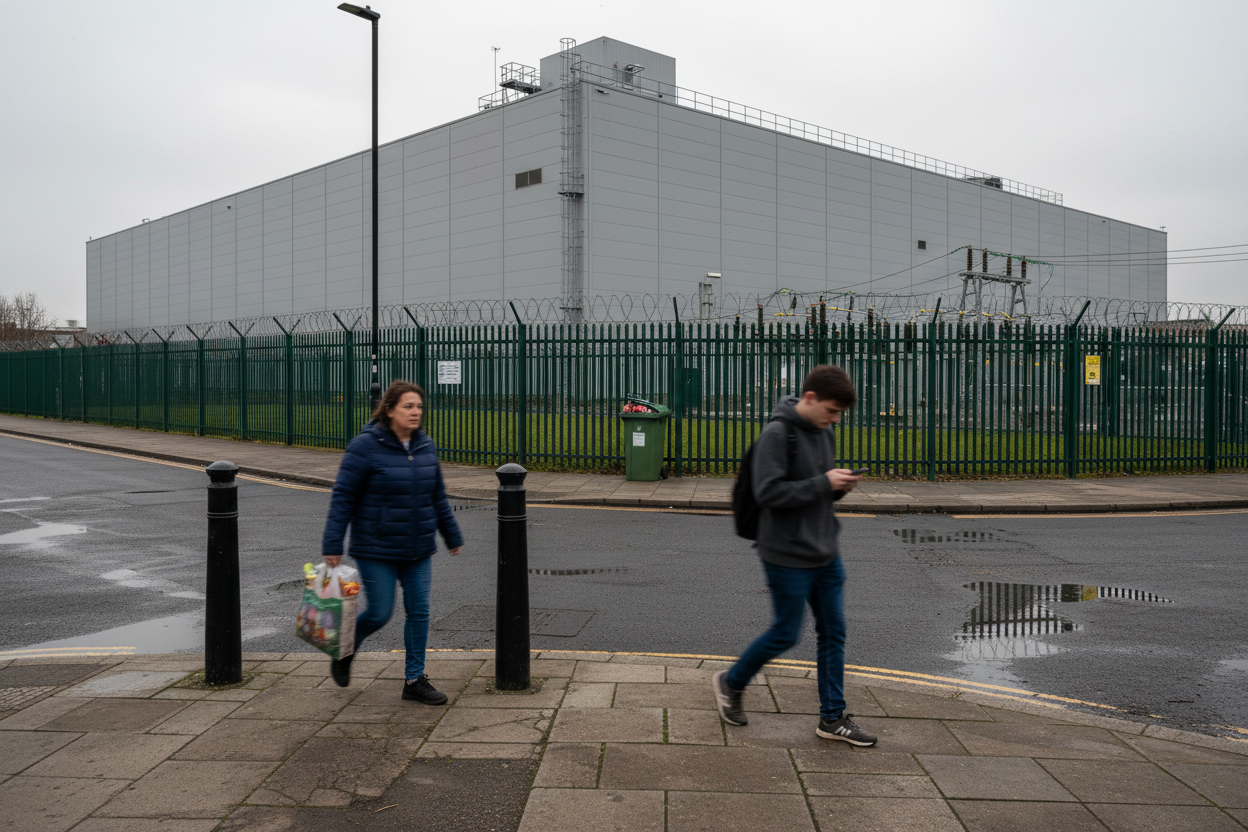
London's growing number of data centres could push 10,000 households in the capital into fuel poverty and put heavy pressure on water supplies, experts have told the London Assembly.
Data centres are secure, warehouse-like buildings that hold IT infrastructure such as computing, storage and networking systems. They are seen as critical to the capital's economy and public services. Many of them are built in and around London because the City of London's financial hub is nearby, and because of a 'snowball effect': new centres tend to be built in clusters near existing ones.
London already has 99 data centres, which is more than 80% of the UK's data centre capacity. Another 26 are planned or working their way through the system.
The cost to household bills
Oliver Hayes, head of campaigns at Global Action Plan, told the Assembly's environment committee this week that if data centres grow as fast as the high-growth projections suggest, 77,000 British households could be pushed into fuel poverty because of higher energy bills. Ten thousand of those would be in London. The climate campaign group's research suggests the extra demand on the UK's energy systems could add an average of £88 to household energy bills.
"It will also further impoverish the households already in fuel poverty," Hayes said. "This is an enormous issue that is not being adequately considered. Early analysis of that at a regional level suggests that in London that figure would be about 10,000 additional households."
Zack Polanski, leader of the Green Party and a London Assembly Member who sits on the committee, told the Local Democracy Reporting Service: "We need to slam the brakes on the rampant building of new data centres. So many Londoners are already struggling with the toxic combination of sky-high bills and low wages. Building more data centres risks pushing tens of thousands more households into fuel poverty, and that's especially worrying here in London, where so many data centres are being proposed."
He added that at a time of housing emergency, "we cannot afford to prioritise data centres ahead of the homes our city desperately needs."
Pressure on water
Assembly members also heard that data centres use large amounts of water, which could cause problems at times of peak demand in summer.
Jon Chappell, deputy director of Water UK, said: "We build our system to meet the highest point of demand in the year. If you have a big extra new demand in summer, that increases the peak. That means you have to increase the size of your service reservoirs and your treatment works."
He said that if every new data centre were built like the least efficient one now operating, the country would need an extra 77 million litres of water a day, the equivalent to three London boroughs. He warned that "in the east of England and in the southeast of England, there are places where houses cannot be built and businesses cannot expand already for no other reason than a lack of water."
Rory Murphy, a research associate at the University of Exeter, said the headline figures capture only part of the true cost. In one year, he noted, US data centres used 66 billion litres of water directly to cool their servers, but 800 billion litres were used to keep the servers running in the first place. "We need to consider the wider indirect effects, particularly when considering the stress that this could place on an already stressed infrastructure," he said.
What City Hall says
Last year, Labour Assembly Member James Small-Edwards asked the Mayor of London about the issue. The Mayor said he had commissioned a study into what new data centres mean for the capital's water supply. He noted that some data centres need water for cooling and others use air or other non-water systems, so "the impact of data centres on water infrastructure and supply can therefore vary considerably."
Earlier this year, he told assembly members that City Hall was looking at the water and grid impacts of data centres, adding: "That is why we need a proper comprehensive plan for London."
The draft London Plan, which guides councils on planning, says data centres in suitable locations should be supported in principle. It adds that they should only get the go-ahead if there is enough water and electricity capacity.